Springs & Shims
Springs
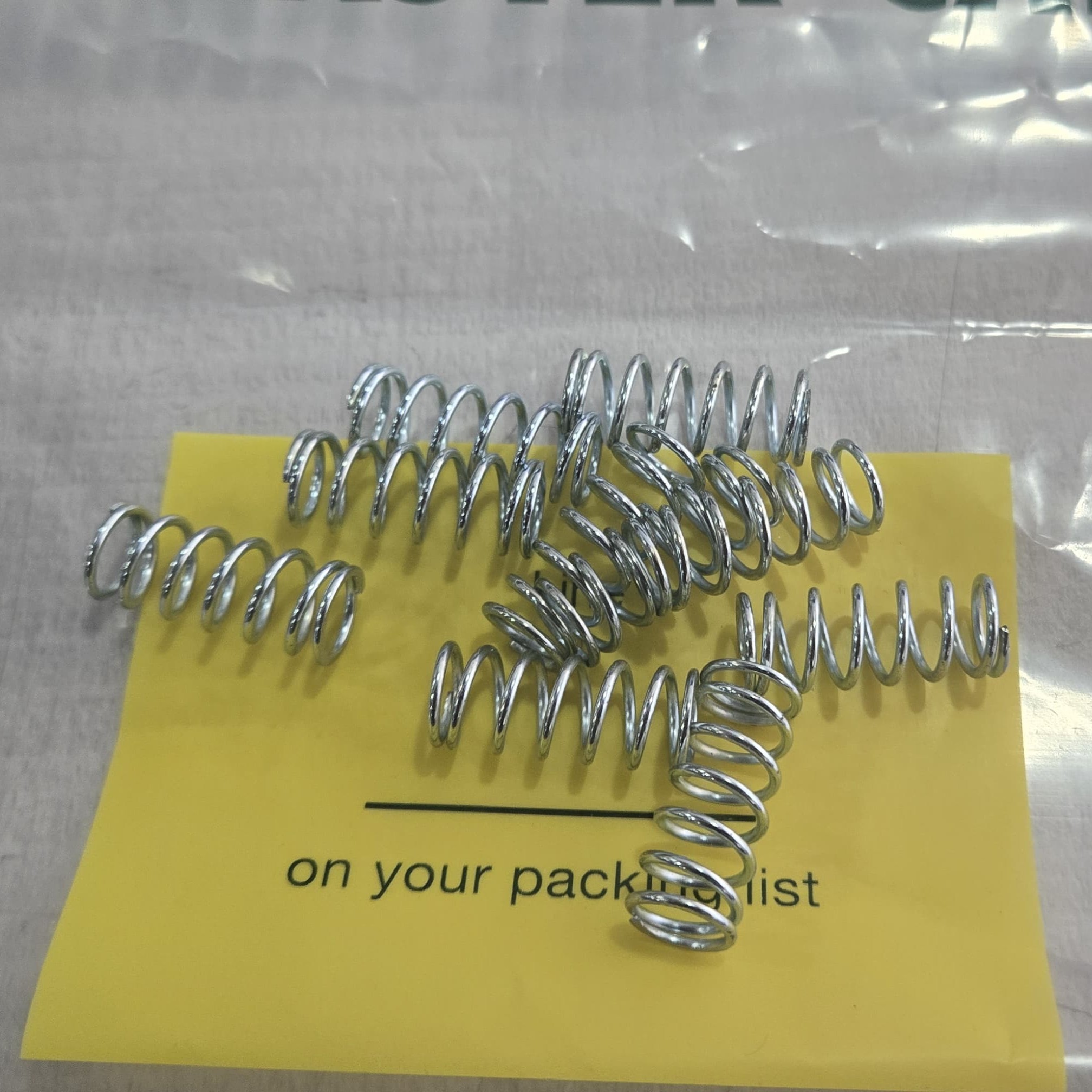
Prauna precision springs are coil-wound and ground from high-quality wire in music wire (ASTM A228), hard-drawn (ASTM A227), stainless 302/304 (ASTM A313), and chrome-silicon (ASTM A401) to deliver consistent spring rates, accurate free lengths, and long fatigue life. Compression, extension, and torsion types stocked in thousands of standard sizes with custom coiling available from single-piece samples to high-volume production.
Key Features
Technical Specifications
Product Description
Prauna springs are precision-coiled on CNC spring-coiling machines with computer-controlled pitch programming to achieve consistent spring rates across the entire coil body. Compression springs with ground and closed ends are surface-ground to ensure perpendicularity of less than 1° and parallelism within 0.5 mm.
Music wire (ASTM A228) offers the highest tensile strength of standard spring materials and is the default choice for general-purpose compression and extension springs in ambient temperature environments. Chrome-silicon alloy wire (ASTM A401) is specified where elevated temperatures, high stress, or extended fatigue life is required.
Custom spring design is supported by our engineering team using spring design software to optimise coil geometry for your load-deflection requirement, stress level, and fatigue life target. CAD models in STEP and IGES format are available for customer review prior to tooling.
Industry Applications
🖥️ CNC & Automation
Toolholder retention springs, die springs, actuator return springs
🚗 Automotive
Valve springs, suspension springs, brake caliper return springs
🔬 Medical Devices
Surgical instrument springs, IV pump mechanisms, diagnostic equipment
⚡ Electronics
Battery contacts, switch springs, connector retention, EMI shielding fingers
🏭 Industrial Machinery
Clutch springs, pressure relief valves, die ejector springs
🏗️ Construction Equipment
Vibration isolators, safety lock springs, hydraulic valve springs
Installation Guidelines
Compression Springs: Install in a bore or over a pin with diametral clearance of 10–15% of the spring OD (bore) or 10% of wire diameter (pin). Ensure working height does not exceed solid length. Design working deflection at 80% or less of maximum deflection range for reliable performance.
Extension Springs: Attach hooks to fixed pins or shoulder bolts to prevent side loading. Initial tension (pre-load) is built into extension springs and must be overcome before deflection occurs — account for this in load calculations.
Torsion Springs: Mount on a shaft whose diameter is 90% of the spring ID. Ensure the legs are loaded in the direction that closes the coil — loading in the opening direction reduces service life.
Maintenance & Care
Inspection Schedule: Inspect for coil cracking, pitting, or permanent set every 6–12 months. Measure free length against original specification — replacement recommended at 3% or greater loss in free length. Check end coils (compression) for wear against mating surfaces.
Lubrication: Light machine oil or grease reduces coil-to-coil wear in closely wound springs operating in oscillating applications. Springs in food-grade applications must use NSF H1 approved lubricants.
Fatigue Failure Prevention: Springs operating near their stress limit will fatigue-fracture without warning. For safety-critical applications, schedule preventive replacement at 80% of the design fatigue life. Shot-peened springs provide a 20–30% improvement in fatigue life.